Recently, a research team led by Professor Lei Xu from the Department of Physics at The Chinese University of Hong Kong (CUHK), together with their collaborators, successfully developed a novel silica nanomaterial based on physical adsorption. Composed of colloidal silica nanospheres, this innovative material features an exceptionally high specific surface area.
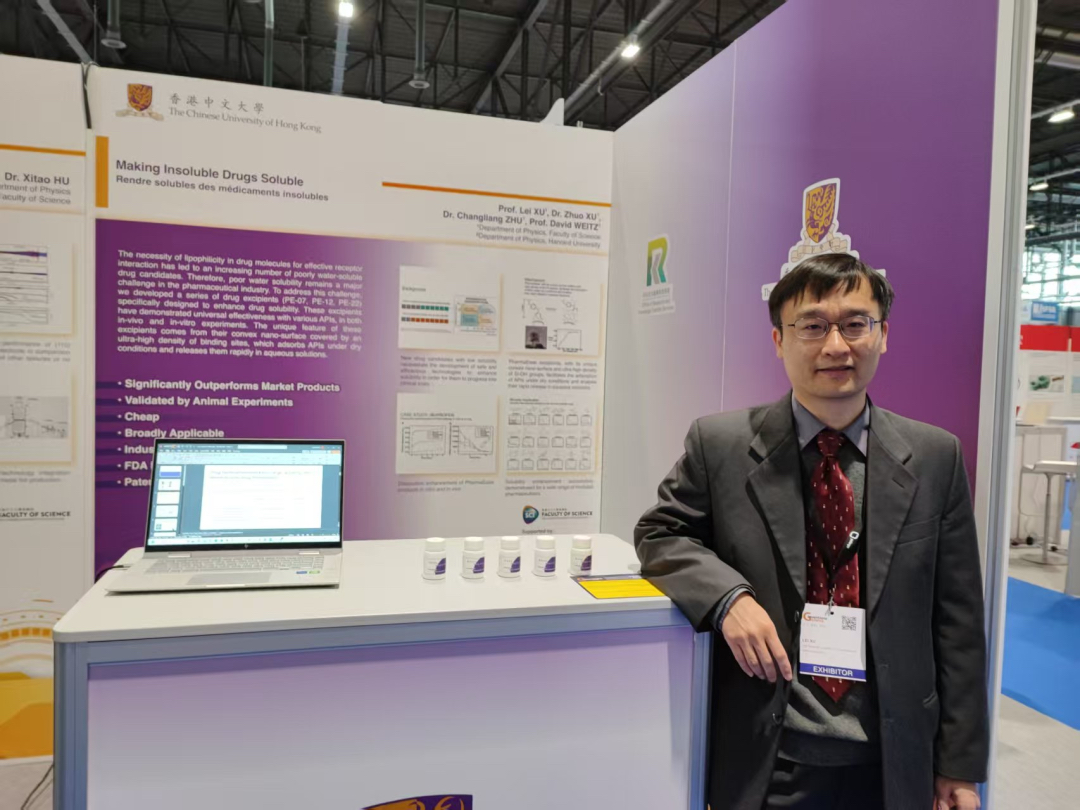
More importantly, through a proprietary treatment method developed by the research group, the density of silanol groups on the material’s surface reaches more than four times that of conventional silica materials.
This property endows the material with an unprecedentedly strong capacity to adsorb drug molecules, while also demonstrating a significant affinity for water molecules.
Based on this property, the research team discovered a novel phenomenon: when crystalline drugs are mixed with this silica nanomaterial under dry conditions, the drug molecules transform into an amorphous state and are adsorbed onto the material’s surface. When the mixture is immersed in water, the material preferentially adsorbs water molecules, causing the previously adsorbed drug molecules to be released and form a supersaturated drug solution. This demonstrates that water molecules can be transformed from a traditionally solubility-limiting factor into a solubilizing factor that promotes drug dissolution.
This discovery not only reveals a new mechanism governing the adsorption and desorption of substances on silica surfaces, but also provides a completely new solution to the bioavailability challenge of poorly soluble drugs.
It is expected to significantly improve the water solubility and bioavailability of drugs, enhance therapeutic efficacy, and potentially revitalize drug development projects that have been shelved due to solubility issues.
In addition, the research findings provide a theoretical basis and technical support for the design of more efficient drug carrier systems, offering broad application prospects.
Recently, the relevant paper, entitled Enhancing Drug Solubility through Competitive Adsorption on Silica Nanosurfaces with Ultrahigh Silanol Densities, was published in PNAS [1].
Zhuo Xu is the first author. Professor Lei Xu from the Department of Physics at The Chinese University of Hong Kong and Professor David A. Weitz from Harvard University in the United States are the co-corresponding authors.
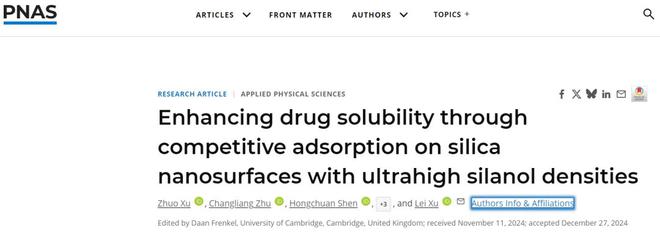
Figure | Related paper (Source: PNAS)
Lei Xu stated, “This paper took only six weeks from submission to acceptance, which underscores the peer recognition of our work.”
Reviewers commented, “This study presents a technology that is significantly superior to existing methods, with performance improvements of up to two to three orders of magnitude in some cases. It has the potential to become a next-generation drug delivery platform.”
They further noted that, by increasing the density of silanol groups on the nanoparticle surface, the technology not only accelerates the release rate of hydrophobic drugs but also substantially increases their release payload. Combined with density functional theory calculations, the study is the first to thermodynamically validate the advantages of this process, in stark contrast to previous methods. The reviewers also noted that this achievement is expected to have a far-reaching impact on the pharmaceutical industry and further advance the development of hydrophobic drug delivery technologies.
First, it can be applied to targeted drug delivery systems.
As modern medicine advances toward the era of precision medicine, the research and development (R&D) and application of targeted drugs have become a key direction for treating complex diseases, such as cancer and immune-related diseases. However, many novel targeted drugs, including proteolysis-targeting chimeras (PROTACs) and small-molecule inhibitors, often face critical challenges such as poor solubility and low bioavailability due to their high specificity and complex molecular structures, which greatly limit their clinical application.
The team’s technology is based on molecular-level interactions, aligning closely with the R&D logic of targeted drugs. By developing silica nanomaterials with a high density of silanol groups, it provides a new delivery solution for these poorly soluble drugs. Preliminary experimental results show that the technology can significantly enhance the release efficiency and stability of CRBN E3 ligase ligand-based drugs. This delivery system is expected to become a standard component of next-generation precision medicine, facilitating the translation of more targeted drugs from the laboratory to the clinic.
Second, it enables the repurposing of poorly soluble drugs.
Many drug candidates shelved due to solubility issues may be revitalized by this technology. By converting them into a stable amorphous state and enabling efficient delivery, these “failed drugs” can re-enter clinical trials, shortening the new drug R&D cycle and reducing costs.
Third, it holds potential for the delivery of gene therapy and biologic drugs.
While the technology currently targets small-molecule drugs, its molecular-level mechanism also opens up possibilities for future expansion into the delivery of gene therapy vectors or biologic drugs, such as antibodies and nucleic acid drugs, further broadening its application scope.
In recent years, advances in scientific research and a deeper understanding of disease mechanisms have made the R&D of new drug molecules increasingly complex and costly.
This challenge is particularly evident in the field of small-molecule drugs. Although many candidates demonstrate excellent efficacy at the cellular level, their high lipophilicity often results in poor water solubility, preventing them from achieving the expected effects in clinical trials.
Statistics show that approximately 60% to 70% of small-molecule drugs fail due to solubility issues [2]. This not only increases R&D costs but also delays the launch of new drugs.
This study was conducted against the backdrop of this critical challenge. Specifically, the research team aimed to develop a universal drug delivery system to improve the water solubility and bioavailability of poorly soluble drugs.
Through this approach, the team hopes to revitalize potentially effective drugs that have been abandoned due to solubility problems and significantly improve the success rate of new drug R&D.
In addition, this delivery system is expected to shorten the translation cycle from laboratory research to market launch and reduce R&D costs, thereby accelerating the development of innovative therapies and providing more treatment options for patients.
Initially, Lei Xu and his colleagues focused on exploring the mechanism underlying this phase transition. They discovered that when crystalline drugs are mixed with the team’s colloidal sphere assemblies, the crystals are converted into an amorphous state.
Based on classical nucleation theory, the research group focused on altering pore size and designed a series of experiments to verify the relationship between drug nucleation and nanomaterials. However, they found that surface modification had a more significant impact on the experimental results than pore size.
As the experiments progressed, the research team further observed that this modification method could not only alter the physical form of drugs but also significantly improve their solubility.
Subsequent studies demonstrated that, under appropriate conditions, the modified drugs could achieve an extremely high supersaturated state. This represented a major breakthrough for the team, as it pointed to a potential solution to the critical challenges faced by many poorly soluble drugs.
During this period, the research group focused on optimizing the nanomaterial preparation process and evaluating its effects on different drugs to identify the most effective formulations.
After confirming the technology’s effectiveness and broad applicability, the research team began to consider its commercialization. The first challenge they faced was translating the lab-scale technology into practical products.
To this end, they established collaborations with multiple pharmaceutical companies to jointly explore the application of this technology in existing drugs. Meanwhile, the team secured funding from the Hong Kong government for commercialization projects, providing the necessary financial support.
Following initial success and technological recognition, the research team founded the startup PharmaEase Tech Limited in 2023, dedicated to developing drug delivery solutions based on this technology.
PharmaEase Tech focuses on developing cutting-edge nanotechnology-based drug delivery solutions, particularly for addressing the challenges of poorly soluble drugs. The team’s core technology is derived from research on silica nanomaterials with high silanol group density, which can significantly improve drug solubility and bioavailability, thereby enhancing therapeutic efficacy.
Currently, the company is actively advancing product R&D and preclinical testing, with the goal of bringing this innovative technology to market as soon as possible to benefit more patients.
Although the journey may appear smooth on the surface, the team has in fact overcome numerous obstacles. Initially, Lei Xu’s team focused on fundamental physics research, operating in a research environment and under conditions vastly different from those they face today.
Shifting to application-oriented research was an enormous challenge. Every step, from experimental design to mindset adjustment, required relearning.
Lei Xu still clearly remembers the first time the team conducted experiments based on theoretical hypotheses. At the time, the team set their goals with great confidence, but reality quickly dampened their spirits. Experiments failed one after another, and those days were filled with frustration.
In addition to internal challenges, the team also faced significant external pressure. Investors repeatedly raised doubts, questioning whether the technology could truly move beyond the laboratory. In response, the research team obtained samples from commercial partners and used strong experimental results to demonstrate to investors that their technology remained highly competitive when applied to commercial products.
Through these interactions, the research team not only gained investors’ trust and support but also received valuable feedback, which helped them further optimize the technology and business model.
Looking ahead, Lei Xu plans to collaborate with pharmaceutical companies to expand the technology into the latest areas of drug R&D, including targeted drugs and biologic drugs.
References:
1.https://www.pnas.org/doi/10.1073/pnas.2423426122
1.D. V. Bhalani, B. Nutan, A. Kumar, A. K. Singh Chandel, Bioavailability enhancement techniques for poorly aqueous soluble drugs and therapeutics.Biomedicines10, 2055 (2022).